Content repurposing system: blog → social → email → video from one piece
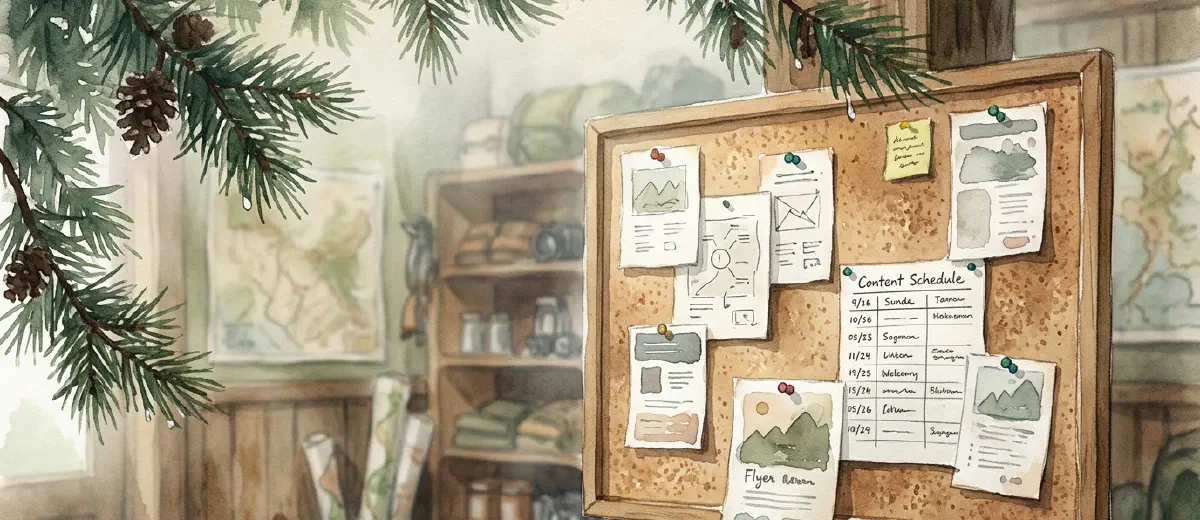
Most outdoor operators write one blog post and then move on. That’s leaving a lot on the table.
A single well-built piece of content - a trip report, a gear guide, a seasonal prep article - can power your Instagram feed, your email newsletter, your YouTube channel, and your Google search rankings at the same time. That’s the content repurposing system. Not a fancy marketing concept, just a structured workflow for getting more out of what you’re already producing.
Businesses that repurpose content consistently see around 30% more organic traffic than those creating one-off pieces. More practically for your operation: you write it once, then you’re done writing for that topic for two weeks.
Start with something worth repurposing
Not every post deserves the full treatment.
The pieces worth repurposing have clear utility, specific local or activity-based detail, and a natural visual angle. For an outdoor operator, those are: trip reports with real conditions and photos, gear and safety guides, destination or seasonal prep content (“what to expect on the Colorado River in June”), and FAQ-style posts that answer what customers ask before they book.
Posts that are too narrow, too promotional, or too thin don’t repurpose well. A 400-word post about your new booking system won’t become a YouTube video anyone watches.
Trip reports are the most underused format here. A single guided trip - say, a half-day raft on the New River Gorge or a morning kayak tour in the San Juan Islands - generates real photos, real conditions, real guest reactions, and real local detail. That’s everything you need for a blog post, three Reels, an email, and a Pinterest pin. Most operators either don’t write them up at all or bury them in a generic “we had a great day” paragraph that’s useless for repurposing.
When you sit down to write, go longer than you think you need to. A 1,200-word post gives you material to pull from. A 600-word post gives you almost nothing. Depth is what makes repurposing possible.
The core framework: one post, four formats
Here’s how one blog post becomes content across four channels. The whole workflow takes 45–90 minutes after the original post is live.
The blog post is the anchor. It covers the full topic, earns search traffic, and contains all the raw material. Everything else is extracted from it, not written from scratch.
Email gets the condensed version. Take the most actionable 300 words from the post - the specific tip, the concrete example, the one thing your reader can do this week - and write it as a short newsletter. Link back to the full post for anyone who wants more. This covers both your weekly email and a drip sequence for new subscribers. Email marketing for outdoor recreation is its own subject, but repurposing is how you feed it without running dry.
Social gets the fragments. A single long post yields at least five pieces: a data point as a graphic, a pull quote for a text post, a “before and after” tip as a carousel, a question to spark comments, and a short clip or screen recording. Buffer’s own framework puts the floor at five social posts per long-form piece. Some posts yield ten.
Video gets the walkthrough. If you’re already producing short video content, your blog post becomes the script - or at least the outline. A 60-second Reel explaining the main point, a YouTube Short with the top tip, or a full 5-minute guide video for your channel. Behind-the-scenes content your guides can film pairs naturally here.
The actual workflow, step by step
This is how it runs in practice, not in theory.
Day 1: write and publish the blog post. While writing, tag any pull quotes (put brackets around them), flag the “video moment” - the one section that could stand on its own as a 60-second explainer - and note the one actionable tip for email.
Day 2 or 3: record your Reel or Short. Use your bracketed section as the script. If you’re on a trail, film on trail. If it’s a gear post, film at your shop. One take is fine. Nobody’s expecting production value from a rafting guide.
Day 4: write the email. Copy your flagged section, tighten it to 250–350 words, add a subject line, add a link back to the post. That’s it.
Days 5–7: schedule social posts. One per day for the next week, all pulled from the same post.
The blog post you wrote on Monday becomes your content through the following Sunday. One writing session, seven days of output.
Tools that actually help
You don’t need an elaborate stack. Two tools do most of the work.
Descript ($24/month) transcribes video or audio automatically. Record a short walkthrough for your Reel, and Descript converts the transcript into a starting draft for your blog post or email. It also edits video by editing text - which matters a lot when you’re not a video editor and don’t want to become one.
Repurpose.io ($32/month) handles the mechanical distribution. Post your Reel to Instagram, and it automatically pushes the same video to TikTok and YouTube Shorts - no manual upload, no reformatting. For a one-person operation trying to maintain presence on three platforms, that’s the whole pitch.
Both have free trials. Test on one post before committing.
For scheduling, Buffer’s free plan handles up to three channels. If you’re managing Instagram, Facebook, and LinkedIn, that’s enough. Don’t pay for a scheduling tool until the free tier is genuinely limiting you.
Where outdoor content repurposes best
The channel hierarchy matters. Not every format drives bookings equally.
Email converts better than social for direct bookings. Someone who opened your last three newsletters is more likely to book than someone who liked your Reel. Build toward email, use social to fill the list.
Instagram Reels get more organic reach than static posts for outdoor content right now - the visual medium fits naturally. A 30-second clip of the Salmon River in September will outperform a photo of the same scene.
YouTube is the long game, but it’s worth playing. Search traffic from YouTube compounds the same way blog traffic does. A “what to expect on your first guided kayak trip” video you made in 2024 still drives views in 2026. Short-form video content ideas for outdoor businesses has 50 starting points if you’re stuck on what to make.
TikTok is real for certain audiences - younger adventure travelers, group trips, anything with strong visual drama. If your customer base skews 18–35, don’t write it off. Repurpose.io means you’re already there once you post on Instagram.
The mistake most operators make
The most common failure isn’t producing bad content. It’s producing content in silos.
An operator writes a great trip report, publishes it on the blog, then writes something completely different for Instagram, then writes a separate email about something else entirely. Three pieces of work, three small audiences reached, nothing reinforcing anything.
Most outdoor operators I’ve seen struggle with content aren’t doing too little - they’re doing it wrong. They’re treating each channel as its own content demand instead of one channel feeding the rest.
The repurposing system forces consistency. When everything in a given week points back to the same core piece, your audience hears the same message across different channels. That repetition is how ideas stick and how bookings happen from people who were on the fence.
We’ve seen operators post once a week on the blog and turn it into a full content week - email, two Reels, five social posts, one YouTube Short - without any additional writing after day one. The blog does the heavy lifting.
Building the habit
The system breaks down when repurposing becomes a separate task you have to schedule. The fix is to make it part of writing, not after writing.
When you finish a draft, spend 10 minutes before you hit publish: highlight one pull quote, note the video moment, write two sentences for the email teaser. That’s the whole prep. Everything downstream takes 20–30 minutes each when you have those three inputs ready.
The operators who struggle with this aren’t lazy. They’re just treating repurposing as a creative act - something that requires fresh energy and a separate sitting. It doesn’t. Once you have the source material, the rest is extraction. You’re not writing; you’re copying and trimming.
After a few weeks of running the system, it stops feeling like work. The blog post goes up, you pull the five social pieces in 25 minutes, you send the email the next morning, and the Reel goes up Thursday. The channel stays active, the audience stays warm, and you haven’t written a single additional sentence.
Turning one guided trip into 10 pieces of content covers the video-first version of this system - if you’d rather start with footage and work backward to the blog, it’s the same logic in reverse.
Pick your next scheduled post. Before you publish it, run the 10-minute prep. The week’s content will mostly write itself from there.


